 Anthony McGrath
Home › News › Shopify development
Shopify development fees: avoid flat-rate quotes for SME sites
Flat fee quotes for Shopify sites often miss key costs like product variations, shipping or post-launch tasks leading to losses.
Quick answer
Flat fee quotes for Shopify development often overlook product and shipping complexity, causing losses. Itemised estimates prevent this by splitting design, products, payments, shipping, and testing.
Key takeaways
- Flat fee quotes miss key e-commerce tasks raising hidden costs
- Estimate work in design, product setup, payment, shipping, testing
- Clients should handle product details; developers configure the site
Infographic. This infographic shows a practical breakdown of Shopify e-commerce build time by task category to better estimate fees and avoid losses from flat rate quotes.
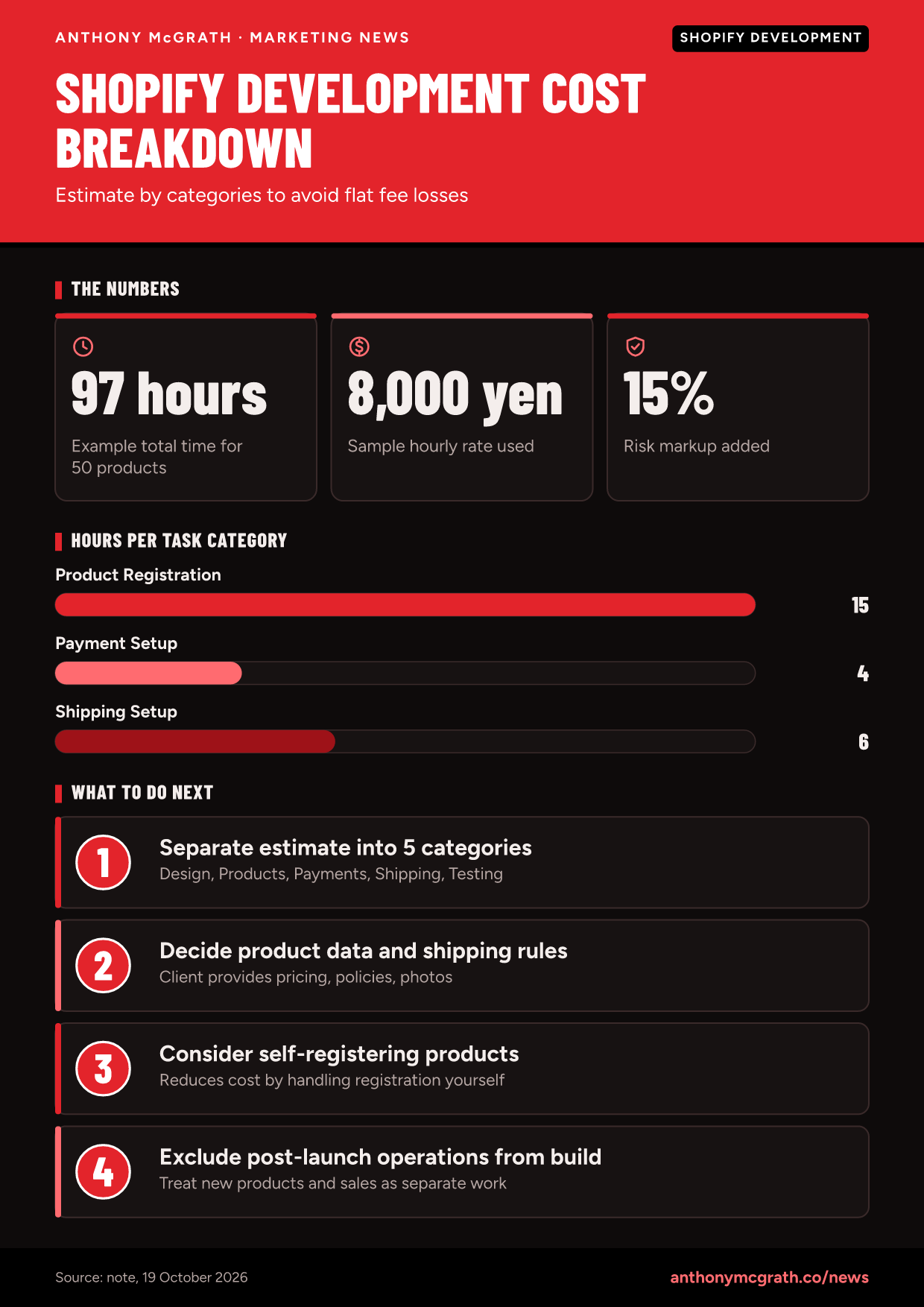
Building a Shopify e-commerce site for your SME is more complex than just picking a theme and listing products. The article by ConstDX on Note explains why flat fee quotes often cause losses. You need to separate costs for screen design, product registration, payment setup, shipping, and testing.
Clients frequently expect a site can be built cheaply and quickly. But the real workload comes from handling product variations, complex shipping rules, and legal requirements that affect the price.
Separating estimates helps in three ways. First, effort depends on quantity and complexity, not just design. Second, it clarifies what you, the store owner, have to decide, like pricing and return policies. Third, post-launch operations like product updates should be quoted separately to avoid confusion.
Shopify development fees include these five categories: (1) design and theme setup, (2) product registration and variants, (3) payment methods and testing, (4) shipping and delivery settings, and (5) launch and final testing. You can opt to register products yourself to reduce costs.
Make sure your estimate clearly states that service fees and transaction charges are paid directly by your store account. Also, anything beyond launching the site, such as adding new products or promotions, should be a separate operation cost.
The full article Shopify Development Fees: Why Quoting a 'Flat Fee' for SME E-commerce Site Construction Leads to Losses provides a detailed breakdown and example calculations.
How should I estimate Shopify development costs?
Break your estimate into design, products, payments, shipping, and testing. Ask your developer for a detailed unit price for product registration. Decide your shipping, pricing, and legal terms yourself before the build.
What it means for you
Ask for a detailed, itemised quote that separates setup and ongoing operations. Consider registering your products to save money. Check the official Shopify fee pages regularly for up-to-date costs.
For checking your site readiness for ads after launch, see my website checklist. Need marketing help? Find out about my Google Ads and SEO services. If you want to talk about your project, just get in touch.
Questions and answers
Why should Shopify development estimates be itemised?
Because the workload depends heavily on product quantity, variations, shipping rules, and post-launch tasks that vary greatly per store. Itemising avoids surprises and clarifies responsibilities.
Can I save costs by registering products myself on Shopify?
Yes. Many developers offer a hybrid approach: they register a few products and create a manual to let you add the rest, which saves time and money.
Do Shopify development fees include ongoing updates and new products?
Usually not. Setting up new products, special features or sales campaigns after launch is a separate operational task and should have its own pricing.