 Anthony McGrath
Home › News › AI search agents
How AI Search and Agents Are Changing Online Tasks
AI tools are shifting from basic chat boxes to autonomous agents that handle live business tasks. Here is what recent moves from Salesforce, Google, and OpenAI mean for you.
Quick answer
AI search is evolving from conversational answers to agentic task completion. As companies like Salesforce and Google build automated agents into everyday platforms, businesses must ensure their websites offer clear product data, fast load times, and structured content so automated systems can easily find and interact with them.
Key takeaways
- Salesforce acquired Braze for $5.66 billion to power automated agent actions.
- Autonomous agents are taking over routine administrative, marketing, and research tasks.
- Websites must be fast and technically clean for automated crawlers to process.
Infographic. This infographic shows key investments and survey figures demonstrating how autonomous software and AI search are moving into day-to-day business operations.
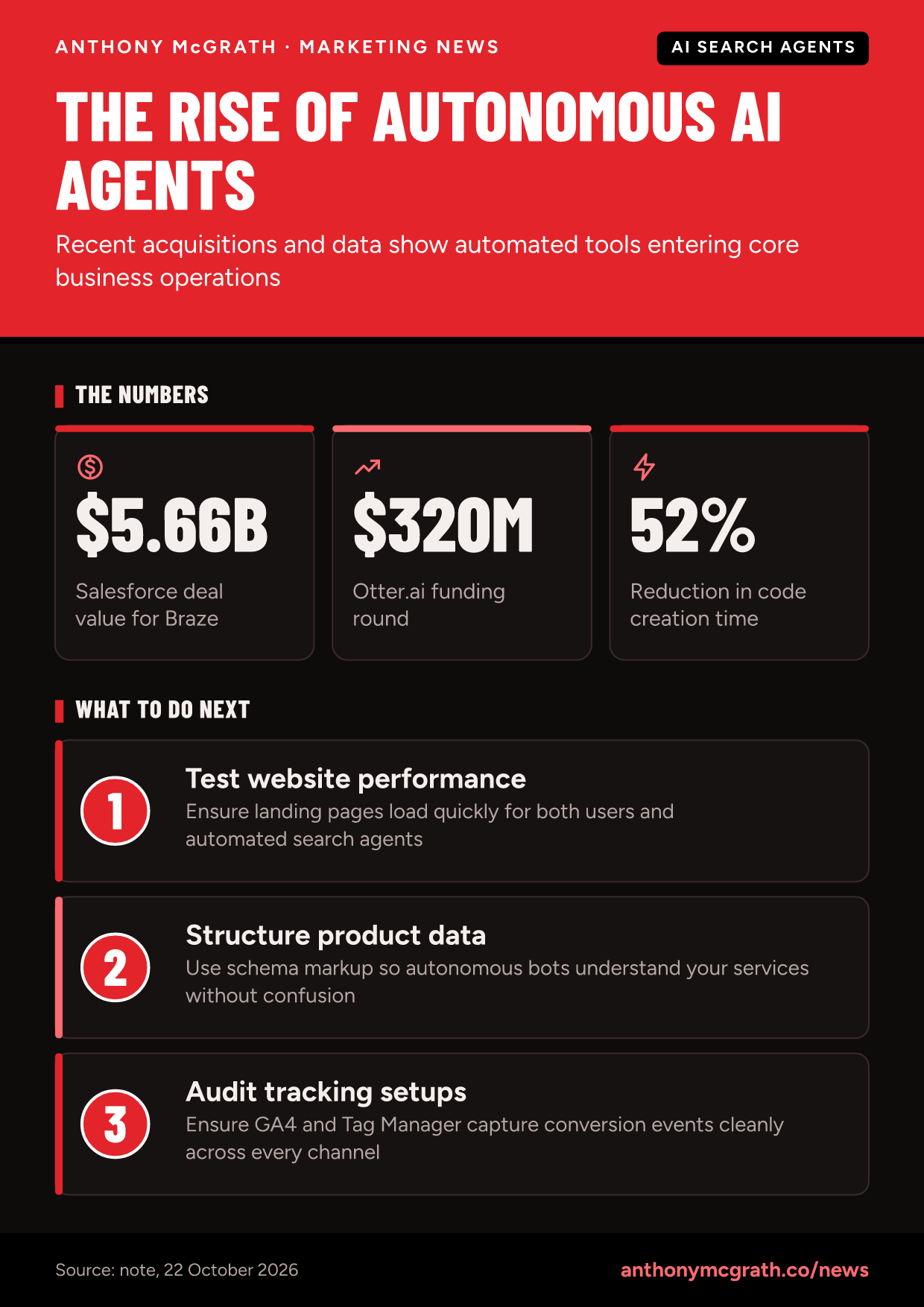
Autonomous software is shifting from experimental lab projects into everyday business infrastructure. According to a roundup published on note on 21 October 2026, tech platforms are moving rapidly beyond simple conversational models. We are now seeing heavy investment in autonomous tools that connect customer data directly to execution, changing how users interact with AI search and business systems.
Several large moves landed at once. Salesforce agreed to acquire customer engagement platform Braze for approximately $5.66 billion, aiming to link real-time user behaviour to automated marketing actions through its Agentforce system. At the same time, OpenAI acquired biotech platform Orchestra Bio, Google Cloud launched a preview of Gemini for public administration tasks, and the UK National Cyber Security Centre published formal guidance on managing autonomous agents safely.
How will autonomous agents affect AI search?
For years, digital marketing relied on users clicking links, filling out web forms, or reading static pages. The growth of agentic tools means automated systems will increasingly browse, filter, and act on behalf of the buyer.
When someone uses modern AI search to source a supplier or book a service, an agent may soon compare pricing, review security standards, and trigger an enquiry without a human visiting five different websites. Understanding the shift towards generative engine optimisation is becoming vital, as explained in my guide on SEO, GEO and AEO differences.
Speed and technical clarity matter here. A survey from the Linux Foundation noted that while generative code tools cut creation time by 52%, low-quality output rose. If your website code is bloated or hard for automated crawlers to parse, agents will simply bypass you.
What it means for you
Automated systems need clean data and fast websites to do their job properly. Take two steps this week:
- Check your technical health. Run your primary landing pages through my free site speed checker to ensure automated bots and users can load your site instantly.
- Audit your forms and APIs. Make sure enquiry forms have clear labels, simple validation, and proper tracking in GA4 so automated and human visits are logged accurately.
Questions and answers
What is an autonomous AI agent in search?
An autonomous AI agent is software that can plan, browse, and execute multi-step tasks across websites without requiring manual guidance for every individual action.
How does agentic automation affect small business marketing?
Instead of browsing multiple websites manually, buyers will increasingly use AI tools to research and book services directly, making clear pricing, structured data, and fast page speeds essential.